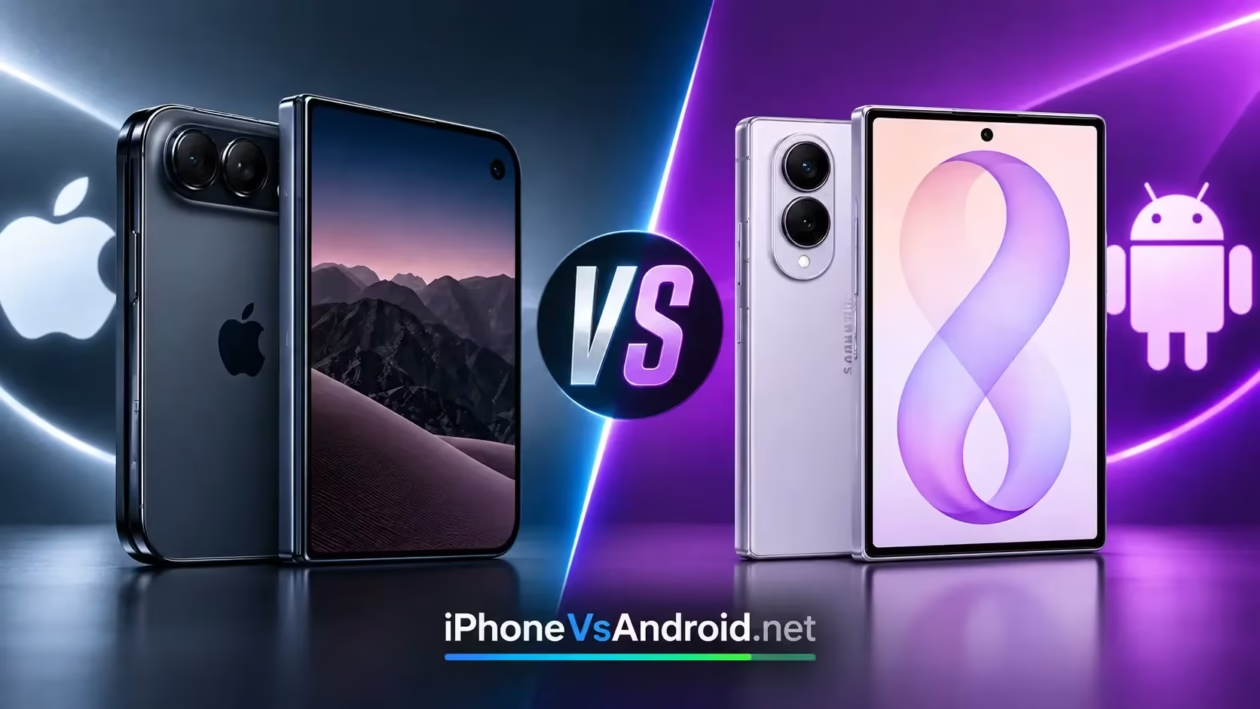
Apple just did something it’s never done in almost 20 years of iPhones: it folds. The iPhone Duo, unveiled at yesterday’s “Surprise and Shine” event, is genuinely the biggest hardware shift Apple’s made since the original iPhone ditched the keyboard. Samsung’s had a five-generation head start with the Z Fold line, so the real question isn’t whether Apple can make a foldable, it’s whether showing up late means showing up better.
Short Answer: “The iPhone Duo has Apple’s newest chip, better water resistance, and a clever dual-battery setup, but it’s also the first-generation product here. Samsung’s Z Fold 7 wins on camera versatility (three rear lenses versus two), it’s thinner and lighter, and it charges faster, five generations of refinement that Apple’s still catching up to. Both cost essentially the same, $1,999. If you’re already deep in Apple’s ecosystem, the Duo is a genuinely strong debut worth getting excited about. If you have no brand loyalty and just want the most capable foldable today, Samsung still wins that argument.”
Quick Comparison
| Feature | iPhone Duo | Galaxy Z Fold 7 |
|---|---|---|
| Inner Display | 7.6″ Super Retina XDR, 1878 x 2670, ProMotion 120Hz | 8.0″ Dynamic AMOLED 2X, 1968 x 2184, 120Hz |
| Outer Display | 5.4″ Super Retina XDR, 1398 x 2034 | 6.5″ Dynamic AMOLED 2X, 1080 x 2520 |
| Peak Brightness | 3000 nits outdoor | 2600 nits peak |
| Display Extras | Nano-texture option, Always-On | HDR10+, Gorilla Glass Ceramic 2 cover |
| Chip | Apple A20 Pro (2nm), 6-core CPU, 7-core GPU | Snapdragon 8 Elite for Galaxy, Octa-core 4.47GHz |
| RAM | 12GB | 12GB / 16GB |
| Storage | 256GB / 512GB / 1TB / 2TB | 256GB / 512GB / 1TB |
| Main Camera | 48MP Fusion (f/1.6) | 200MP (f/1.7) |
| Ultra-Wide Camera | 48MP Fusion (f/2.2) | 12MP (f/2.2, 120° FoV) |
| Telephoto Camera | None | 10MP (f/2.4, 3x optical zoom) |
| Outer Front Camera | 12MP Center Stage | 10MP (f/2.2) |
| Inner Front Camera | Under-display | 10MP (f/2.2) |
| Video Recording | 4K @ 120fps, Dolby Vision | 4K, no confirmed 120fps spec |
| Battery | Dual battery, ~4,883mAh combined | 4,400mAh single |
| Battery Life | Up to 44 hrs outer / 31 hrs inner video | Not officially rated in hours |
| Charging | 20W wired, no wireless charging listed | 25W wired, 15W wireless, 4.5W reverse wireless |
| Biometrics | Touch ID (side button), no Face ID | Side fingerprint sensor |
| Build Material | Grade 5 titanium frame, Ceramic Shield | Armor Aluminum frame, Gorilla Glass Victus 2 |
| Water Resistance | IP68 | IP48 |
| Weight | 254g | 215g |
| Thickness (folded) | 11.3mm | 8.9mm |
| Thickness (unfolded) | 5.2mm | 4.2mm |
| Colors | Star White, Night Sky | Silver Shadow, Blue Shadow, Jet Black |
| Connectivity | Wi-Fi 7, Bluetooth 6, eSIM only | Wi-Fi, Bluetooth 5.4, USB-C 3.2 |
| Operating System | iOS 27 | Android 16, One UI 8 |
| Release Date | Pre-order Oct 16, ships Oct 23, 2026 | Available now |
| Starting Price | $1,999 (256GB) | $1,999.99 (256GB) |
Displays: Apple Goes Bigger on the Outside, Samsung Bigger Inside
Here’s an interesting split most people won’t expect. Samsung’s inner screen is actually larger at 8.0 inches versus Apple’s 7.6, but Apple’s outer display beats Samsung’s, 5.4 inches versus 6.5 sounds backwards until you realize Samsung’s cover screen is genuinely bigger too, at 6.5 inches. So Samsung wins both screens on raw size. What Apple’s betting on instead is refinement, ProMotion, Always-On, and a nano-texture option on the inner display that Samsung doesn’t offer.
Cameras: Samsung’s Experience Shows
This isn’t close, and it’s the clearest sign of Apple being new to this. The Duo ships with just two rear cameras, a 48MP main and 48MP ultra-wide, no telephoto at all. Samsung’s Z Fold 7 packs three: a massive 200MP main sensor, a 12MP ultra-wide, and a 10MP telephoto with genuine 3x optical zoom.
If zoom matters to you at all, Samsung wins outright here. Apple clearly prioritized the folding mechanism and display quality for its first attempt rather than trying to match Samsung’s five generations of camera refinement in one launch.
Performance and Chip
Apple’s A20 Pro is a legitimately new chip built on a 2nm process, and it’s the same silicon powering the iPhone 18 Pro line, no cut-down foldable-specific version. Samsung’s Snapdragon 8 Elite for Galaxy is no slouch either, but Apple’s chip is genuinely newer silicon by manufacturing generation. If raw performance benchmarks matter to you, the Duo likely edges ahead here, though real-world foldable use rarely pushes a phone hard enough for this to be the deciding factor.
Battery and Charging
Apple’s dual-battery approach is a genuinely clever design choice, up to 44 hours of video playback using just the outer display, or 31 hours using the larger inner screen. That’s real flexibility depending on how you use the phone day to day.
Where Apple falls behind: charging speed. The Duo tops out at 20W wired, no wireless charging mentioned in official specs. Samsung’s Z Fold 7 charges at 25W wired plus 15W wireless. Neither of these numbers is fast by 2026 flagship standards, foldables generally lag behind slab phones on charging speed, but Samsung’s still ahead here.
Design and Build
Samsung’s still the thinner, lighter phone here, 4.2mm open and 215 grams, against the Duo’s 5.2mm and 254 grams. For a category where thinness is basically the whole selling point, Samsung’s five-year head start on hinge engineering shows. Apple’s using a titanium frame with Ceramic Shield front and back, and touts a hinge built from over 100 components, a serious first effort, just not yet as refined as what Samsung’s had years to perfect.
Software
This is really where the ecosystem question comes back in. iOS 27 runs on the Duo with what Apple’s calling Split View for the larger inner display, while Samsung’s One UI 8 (built on Android 16) has had years to mature its foldable-specific multitasking, including the desktop-style windowing we covered in our iOS vs Android breakdown. Samsung’s software experience for foldables specifically is simply more mature right now, that’s not a knock on Apple, it’s just an honest reflection of who’s been doing this longer.
Price and Availability
Both start at essentially the same price, $1,999 for the Duo, $1,999.99 for the Z Fold 7, both for 256GB. The Duo’s pre-orders open October 16, shipping October 23. If you’re comparing this to Apple’s regular lineup, this is also officially the most expensive iPhone Apple’s ever sold, and interestingly, Apple’s offering a leasing option specifically for the Duo, worth looking into if the upfront cost is a stretch.
So Which One Should You Actually Get
If you’re deep in Apple’s ecosystem and you’ve been waiting years for a foldable iPhone, get the Duo, it’s a genuinely strong debut, not a half-measure, and the battery flexibility alone makes it worth the switch from a regular iPhone.
But if you have no brand loyalty and just want the best foldable available today, buy the Z Fold 7. Samsung’s had five generations to work out the kinks Apple’s still working through on its first try, better camera, thinner build, faster charging.
Apple caught up fast on the chip. It hasn’t caught up everywhere else yet, and pretending otherwise would be selling you the hype instead of the phone.
Leave a comment