iPhone 17 Pro Max vs Samsung Galaxy S26 Ultra: Which Flagship Actually Wins?
I’ve spent time with both of these, and I’ll say this upfront: neither one is a bad purchase. If you’re stressing over which $1,200+ phone to buy, relax a little you’re choosing between two genuinely great devices. The real question is which set of compromises you can live with.
Here’s how the numbers stack up before we get into what they actually mean day to day.
Wi-Fi 7, Bluetooth 6.0, USB-C 3.2 with DisplayPort
Starting Price
$1,199.99
$1,299.99
Short Answer: If you’re already living in Apple’s ecosystem, care more about battery life than charging speed, and want a camera that just works without fiddling, get the iPhone 17 Pro Max. If you want faster charging, a lighter phone, the more flexible zoom, and the S Pen, get the Galaxy S26 Ultra. Neither is a wrong choice, it comes down to which trade-offs bother you less.
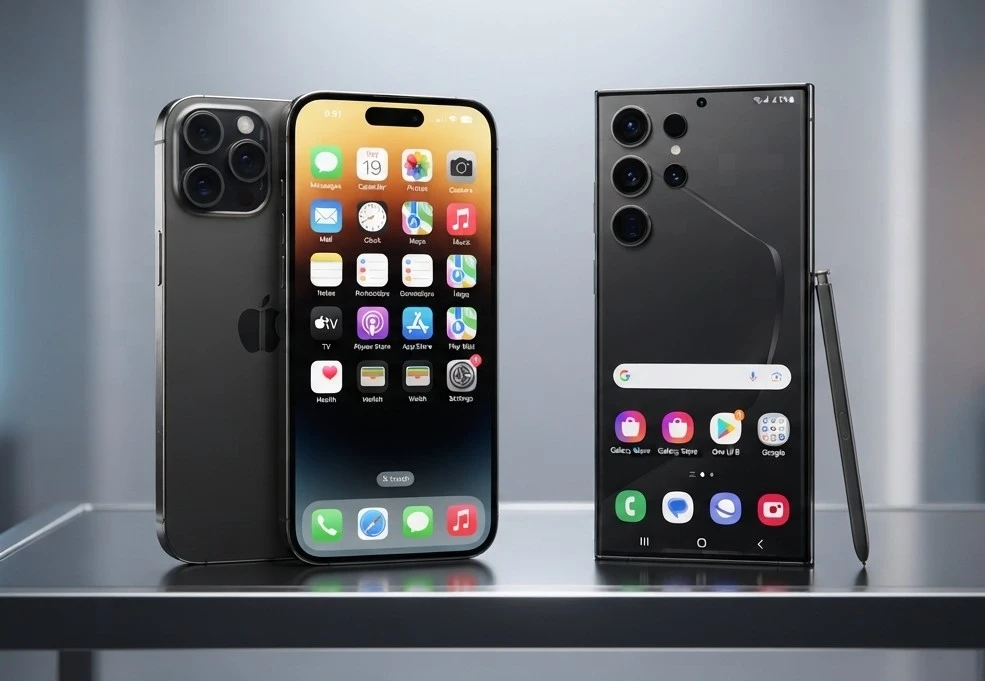
iPhone 17 Pro Max vs Samsung Galaxy S26 Ultra
Design & Build
Pick either one up and you can feel exactly where each company spent its money. The iPhone 17 Pro Max moved to a forged aluminum unibody this year, with a laser-welded vapor chamber built in for cooling. Apple’s clearly betting on sustained performance here, gaming sessions and long video recording, rather than chasing a bigger number on a benchmark chart. Ceramic Shield 2 covers front and back.
Samsung went a different way. Armor Aluminum frame, Gorilla Armor 2 up front, Gorilla Glass Victus 2 on the back. It’s lighter too, 214 grams against the iPhone’s 233, and at 7.9mm it’s the thinner phone by a real margin. Doesn’t sound like much on paper. Hold both back to back for five minutes and you’ll feel it.
One thing worth calling out that doesn’t show up in most comparisons: Samsung’s Privacy Display. It genuinely restricts side-angle viewing, so the guy next to you on the train can’t read your texts over your shoulder. Small feature, but I use it more than I expected to.
Display
Both screens run 6.9 inches at 120Hz, so on a spec sheet they look nearly identical. The gap shows up outdoors. Apple’s panel hits 3000 nits at peak, Samsung tops out around 2600. Doesn’t matter indoors. Matters a lot at noon in July.
Samsung technically wins on resolution with its QHD+ panel. Honestly? I couldn’t tell the difference in daily use, and I don’t think you will either.
Camera
This is where the two phones stop pretending to be similar.
Samsung’s 200MP main sensor is the headline number, but what actually matters is the dual telephoto setup, 3x and 5x optical zoom, both genuinely useful rather than just marketing numbers. Shoot a lot of concerts, sports, anything far away, and that flexibility is real.
Apple didn’t chase the megapixel race. Three 48MP Fusion cameras, an 8x optical-quality zoom that’s the longest Apple’s ever shipped, and a computational approach that leans on consistency over raw sensor size. Colors come out closer to what you actually saw, with less fiddling after the fact.
If I’m being blunt: zoom-heavy shooters should lean Samsung. If you just want to point, shoot, and not think about it, iPhone’s processing is more forgiving.
Performance
Both chips, Apple’s A19 Pro and Qualcomm’s Snapdragon 8 Elite Gen 5 for Galaxy, are the fastest their companies have ever shipped. Neither will choke on anything you throw at it this year, including recent mobile games.
The difference shows up over time, not in a quick benchmark. Apple’s vapor chamber cooling is specifically there to prevent throttling during long gaming or 4K recording sessions. Samsung’s chip benchmarks great too, but Apple made a deliberate bet on holding peak performance longer rather than just hitting a higher number in a 30-second test.
Doing normal stuff, scrolling, texting, half-watching a show while you reply to emails, you won’t notice a difference. This only matters if you game for hours or edit 4K video on your phone regularly.
Battery Life & Charging
Real trade-off here, not a marketing one.
Apple’s calling the 17 Pro Max its best iPhone battery ever, rated for up to 39 hours of video playback. Backed by a larger cell and a more efficient chip, real-world results will vary depending how you use it, but the spec gap alone suggests a real edge over most flagship Android phones.
Samsung wins the other half of this equation. 60W wired charging gets you to roughly 75% in about 30 minutes under good conditions. Apple’s stuck at 40W, faster than older iPhones, still behind Samsung’s pace.
Simple way to think about it: iPhone lasts longer between charges. Galaxy gets back to full faster when you do plug in. If you charge overnight and never think about your percentage, iPhone’s longevity matters more to you. If you top up for fifteen minutes before heading out the door, Samsung’s speed wins.
Software & Ecosystem
Bigger factor than anything above, and it has nothing to do with the actual hardware.
iOS 26 is tightly closed and deeply tied into other Apple devices. If you’ve already got a MacBook or iPad, that lock-in stops being a limitation and starts being genuinely convenient. Handoff, AirDrop, iMessage, all of it just works without setup. If you’re still weighing the bigger ecosystem question before picking a specific phone, our full iOS vs Android breakdown covers that in more depth.
Android 16 with One UI 8.5 hands you more control. Change default apps, sideload outside the Play Store, tweak the interface further than Apple will ever allow. Samsung throws in the S Pen and DeX support for a desktop-style setup when you plug into a monitor. iPhone has nothing that matches this.
Neither one is objectively better here. It’s entirely about what you already own and how much control you actually want.
Price
iPhone 17 Pro Max starts at $1,199.99 for 256GB. Galaxy S26 Ultra starts $100 higher at $1,299.99, also 256GB. The extra camera hardware and included S Pen account for that gap.
Verdict
If you’re already living in Apple’s ecosystem, care more about battery longevity than charging speed, or just want a camera that gets it right without you fiddling, iPhone 17 Pro Max is the safer pick, and it won’t disappoint you.
If you want the most flexible camera setup on the market right now, faster charging, a lighter phone in your hand, and actual freedom to customize your software, plus an S Pen if you sketch or take notes, Galaxy S26 Ultra wins those categories clearly.
I keep coming back to this: you’re not picking a worse phone either way, you’re picking which trade-offs you’re willing to live with for the next few years. That’s a more honest question than “which one’s better,” and it’s the one actually worth answering before you spend $1,200. Curious how the iPhone stacks up against Google’s flagship instead? Check our iPhone 17 Pro Max vs Pixel 10 Pro comparison for that angle.
2 thoughts on “iPhone 17 Pro Max vs Samsung Galaxy S26 Ultra: Which Flagship Actually Wins?”
[…] It’s the sideloading. Installing apps outside the Play Store is genuinely useful if you want that freedom. It’s also how malware actually gets on your phone in the first place. Apple just doesn’t let you do this, outside of the alternative marketplaces the EU forced them to allow. One review process, one gatekeeper, way fewer openings for something malicious to sneak through. If you’re weighing a Galaxy phone specifically, this is worth factoring in alongside everything else in our iPhone 17 Pro Max vs Galaxy S26 Ultra comparison. […]
[…] factoring into a bigger decision too. If you’re weighing an iPhone against a Galaxy flagship specifically, resale is one more point in iPhone’s column, though we found plenty of reasons […]
2 thoughts on “iPhone 17 Pro Max vs Samsung Galaxy S26 Ultra: Which Flagship Actually Wins?”
[…] It’s the sideloading. Installing apps outside the Play Store is genuinely useful if you want that freedom. It’s also how malware actually gets on your phone in the first place. Apple just doesn’t let you do this, outside of the alternative marketplaces the EU forced them to allow. One review process, one gatekeeper, way fewer openings for something malicious to sneak through. If you’re weighing a Galaxy phone specifically, this is worth factoring in alongside everything else in our iPhone 17 Pro Max vs Galaxy S26 Ultra comparison. […]
iPhone vs Android Security: Which Actually Protects You More in 2026? - Iphone Vs Android
[…] factoring into a bigger decision too. If you’re weighing an iPhone against a Galaxy flagship specifically, resale is one more point in iPhone’s column, though we found plenty of reasons […]
iPhone vs Android Resale Value: Which Actually Holds Its Worth in 2026? - Iphone Vs Android