Two phones, two philosophies, one very expensive decision. The iPhone 17 Pro Max and the Samsung Galaxy S26 Ultra represent the absolute ceiling of what each ecosystem offers in 2026, and if you’re choosing between them, you’re not picking a bad phone either way. You’re picking a set of trade-offs that’ll sit in your pocket for the next few years.
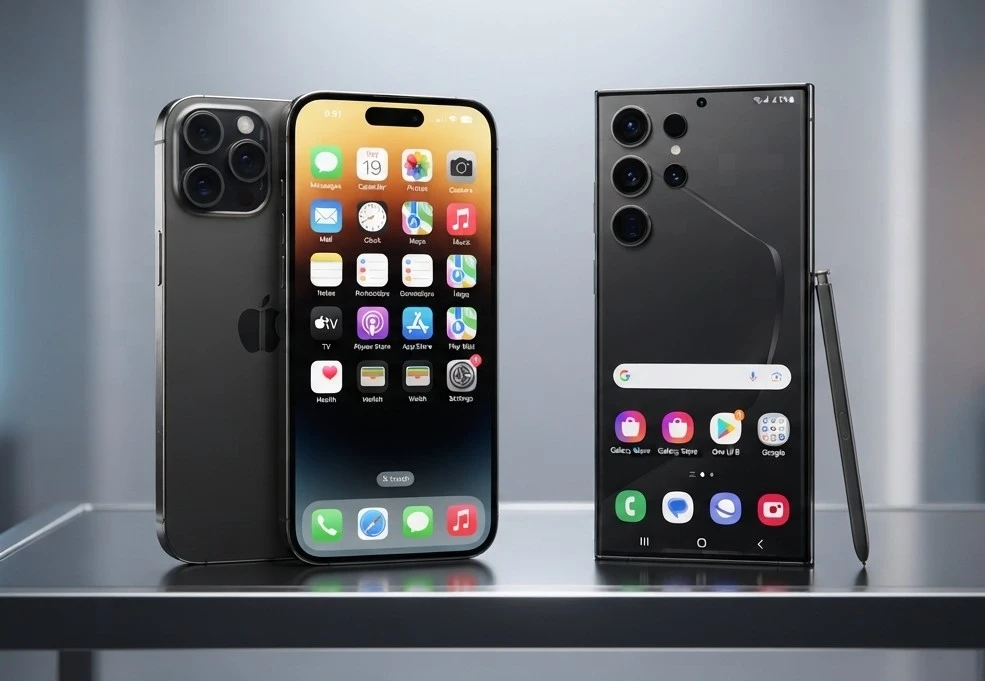
Here’s how they actually stack up, category by category.
Quick Comparison
| Feature | iPhone 17 Pro Max | Galaxy S26 Ultra |
|---|---|---|
| Display | 6.9″ Super Retina XDR OLED, 120Hz, 3000 nits peak | 6.9″ Dynamic AMOLED 2X, 120Hz, 2600 nits peak |
| Resolution | 1320 x 2868 px (~460 ppi) | 1440 x 3120 px (Quad HD+) |
| Chip | Apple A19 Pro | Snapdragon 8 Elite Gen 5 for Galaxy |
| RAM | 12GB | 12GB / 16GB |
| Storage | 256GB / 512GB / 1TB / 2TB | 256GB / 512GB / 1TB |
| Main Camera | 48MP Fusion triple array (Main, Ultra Wide, Telephoto), 8x optical-quality zoom | 200MP wide + 50MP ultra-wide + 50MP telephoto (3x) + 10MP telephoto (5x) |
| Front Camera | 18MP Center Stage | 12MP |
| Video Recording | 4K @ 120fps, Dolby Vision | 8K @ 30fps, 4K @ 60/120fps, 10-bit HDR |
| Battery | ~4,823–5,088mAh, up to 39 hrs video playback | 5,000mAh |
| Charging | 40W wired, 25W wireless | 60W wired, 25W wireless, reverse wireless charging |
| Water Resistance | IP68, 6m for 30 minutes | IP68, 1.5m for 30 minutes |
| Build | Aluminum unibody, Ceramic Shield 2 | Armor Aluminum frame, Gorilla Armor 2 front, Gorilla Glass Victus 2 back |
| S Pen | Not available | Included, 4,096 pressure levels, IP68 rated |
| Dimensions | 163mm approx height (not fully confirmed), 8.8mm thick | 163.6 x 78.1 x 7.9mm |
| Weight | 233g | 214g |
| Operating System | iOS 26 | Android 16, One UI 8.5 |
| Connectivity | Wi-Fi 7, USB-C | Wi-Fi 7, Bluetooth 6.0, USB-C 3.2 with DisplayPort |
| Starting Price | $1,199.99 | $1,299.99 |
Design & Build
Pick either one up and you can feel where each company put its money. The iPhone 17 Pro Max moved to a forged aluminum unibody this generation, with a laser-welded vapor chamber built in for cooling Apple’s clearly leaning into sustained performance for gaming and video work rather than just peak benchmark numbers. It’s protected by Ceramic Shield 2 on the front and back.
The Galaxy S26 Ultra goes a different route: an Armor Aluminum frame with Corning Gorilla Armor 2 up front and Gorilla Glass Victus 2 on the back. It’s noticeably lighter at 214g versus the iPhone’s 233g, and at 7.9mm thick, it’s the slimmer of the two. If you’ve got smaller hands or just don’t want a brick in your pocket, that 19-gram difference is more noticeable day to day than the spec sheet makes it sound.
One Galaxy-only feature worth flagging: a built-in Privacy Display, which restricts side-angle viewing so the person next to you on the train can’t casually read your screen. It’s a genuinely useful addition that the iPhone doesn’t have an equivalent for.
Display
Both phones use a 6.9-inch panel running at 120Hz, so on paper they look nearly identical. The real difference shows up in peak brightness the iPhone 17 Pro Max can hit 3000 nits at its brightest, while the Galaxy S26 Ultra tops out around 2600 nits. In direct sunlight, that gap is enough to notice, especially if you’re trying to read your screen outdoors in summer.
Samsung’s QHD+ resolution panel is also a touch sharper on paper than Apple’s, though in practice, most people won’t be able to tell the difference at normal viewing distance both are genuinely excellent screens.
Camera
This is where the two phones tell completely different stories, and it comes down to megapixels versus computational approach.
Samsung’s headline number is the 200MP main sensor, paired with a 50MP ultra-wide and two telephoto lenses covering 3x and 5x optical zoom. In good light, that 200MP sensor produces extremely detailed shots, and the dual telephoto setup gives you more flexible zoom ranges without digital cropping killing the quality.
Apple went a different direction with three 48MP Fusion cameras Main, Ultra Wide, and a new Telephoto that reaches the longest optical-quality zoom Apple’s ever shipped on an iPhone, at 8x. Apple’s approach leans harder on computational processing to get consistent, true-to-life color rather than chasing raw sensor size.
The honest answer: if you shoot a lot of zoomed-in shots concerts, wildlife, sports from the stands the Galaxy’s dual telephoto and 200MP crop flexibility give you more room to work with. If you want photos that look natural straight out of the camera with minimal editing, the iPhone’s processing tends to be more consistent shot to shot.
Performance
Apple’s A19 Pro and Qualcomm’s Snapdragon 8 Elite Gen 5 for Galaxy are both genuinely the fastest chips their respective ecosystems have ever shipped this isn’t a category where either phone will feel slow for anything you throw at it, including recent-generation mobile gaming.
Where it matters more is sustained performance. Apple’s vapor chamber cooling in the 17 Pro Max is specifically built to prevent thermal throttling during long gaming or 4K video recording sessions. Samsung’s Snapdragon chip benchmarks extremely well too, but Apple’s cooling investment this generation is a deliberate bet on holding peak performance longer, not just hitting a higher number in a 30-second test.
For everyday use browsing, social media, multitasking, you will not feel a difference between these two chips. This one only matters if you’re a heavy mobile gamer or do a lot of on-device video editing.
Battery Life & Charging
Here’s a real trade-off, not a marketing one.
The iPhone 17 Pro Max is rated for up to 39 hours of video playback, and Apple’s calling it the best battery life ever in an iPhone reviewers are backing that up, with the phone consistently outlasting the Galaxy in real-world mixed-use testing.
But when it’s time to plug in, Samsung wins clearly. The Galaxy S26 Ultra supports 60W wired charging, capable of hitting roughly 75% in about 30 minutes under ideal conditions. The iPhone 17 Pro Max charges at 40W, which is faster than previous iPhones but still behind Samsung’s pace.
The trade-off in plain terms: the iPhone lasts longer between charges. The Galaxy gets back to full faster when you do plug in. If you’re someone who charges overnight and rarely thinks about your battery percentage, the iPhone’s longevity matters more. If you’re the type who tops up for 15 minutes before heading out the door, Samsung’s charging speed is the bigger win.
Software & Ecosystem
This is genuinely the biggest factor in this decision, and it has almost nothing to do with the hardware above.
iOS 26 is tightly closed, deeply integrated with other Apple devices (Mac, iPad, Apple Watch), and built around Apple Intelligence. If you already own a MacBook or iPad, the iPhone’s ecosystem lock-in becomes a feature, not a limitation Handoff, AirDrop, and iMessage all work seamlessly across your devices.
Android 16 with One UI 8.5 on the Galaxy S26 Ultra offers far more customization you can change default apps, sideload software outside the Play Store, and tweak the interface in ways Apple simply doesn’t allow. Samsung also bundles in the S Pen and DeX support for a desktop-like experience when connected to a monitor, which the iPhone has no equivalent for.
Neither is “better” here, it depends entirely on what you already own and how much control you want over your device.
Price
The iPhone 17 Pro Max starts at $1,199.99 for 256GB. The Galaxy S26 Ultra starts at $1,299.99, also at 256GB — a $100 premium for the Ultra’s larger camera array and included S Pen.
Verdict
If you’re already inside Apple’s ecosystem, prioritize battery life over charging speed, or want the most consistent camera output without fiddling with settings, the iPhone 17 Pro Max is the safer, more polished pick.
If you want the most flexible camera system on the market right now, faster charging, a lighter phone in hand, and the freedom to customize your software experience including a built-in S Pen for note-taking or sketching the Galaxy S26 Ultra is the better fit, and it’s not particularly close in those specific areas.
Either way, you’re buying the best your chosen ecosystem has to offer this year. The real question isn’t which phone is “better” it’s which trade-offs you’re more willing to live with every day.